There’s a new trend emerging among Generation Z, and it has nothing to do with the latest iPhone, Google Glasses, or virtual reality headset. In fact, it is defined by the absence of all three.
They are choosing to do things “IRL”—in real life.
For a generation raised on screens, the shift feels almost ironic. These are the children of Generation X, a cohort that grew up letting themselves into empty houses after school—fueled by Jell-O pudding pops, frozen burritos, and hours of MTV—people who, as kids, rode bikes to arcades to dump quarters into Donkey Kong, then graduated to Apple IIe computers in college labs, cementing a lifelong relationship with screens.
And yet, their children are walking away from them.
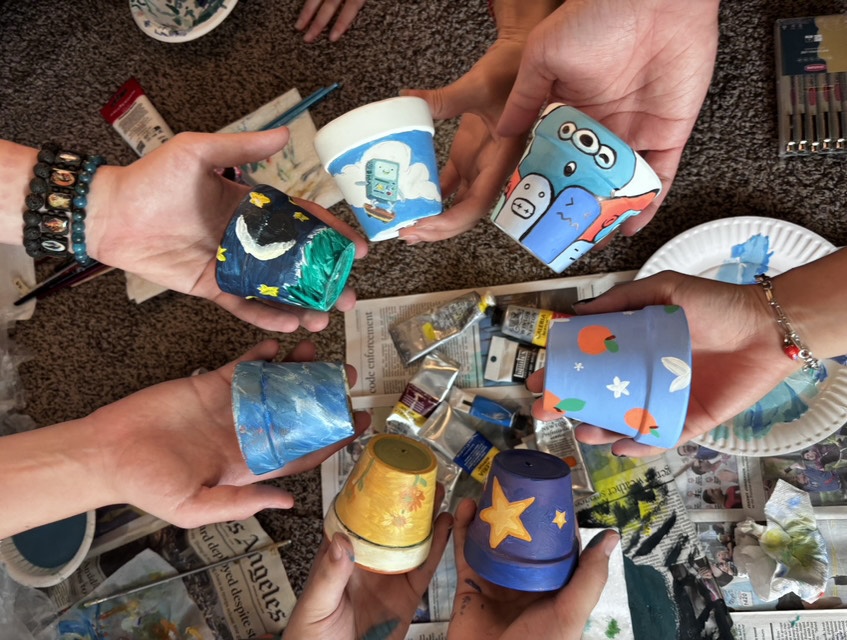
Instead of scrolling, many Gen Zers are picking up “grandma hobbies” like needlepoint and knitting. Others have dove headfirst into live-action role-playing games, activities that require presence and the use of their hands. Vinyl records are back, too—not as a retro gimmick, but as a deliberate choice to engage with music in a physical, grounded way, complete with album art.
The shift is showing up in cultural spaces across the country. In New York City, trendy bars now experiment with enforced quiet, where patrons are expected to whisper rather than shout over music. Add in the rise of board game and cat cafés—equal parts novelty and sensory experience—and a pattern emerges: environments designed to reconnect people with the tangible world.
It is not difficult to imagine where this impulse began.
For many in Gen Z, childhood memories include parents who were physically present but mentally elsewhere—absorbed in the newest smartphone tech, social media feeds and the endless doom scroll.
Street crossings stalled when a parent missed the signal, eyes fixed on a text. Museum visits and family outings split in two—one person absorbed in the moment, the other curating it for Instagram. Shared experiences, but not always shared attention.
According to research conducted by Talker, an independent market research agency that creates online surveys, about half of Americans report making a conscious effort to reduce their screen time in order to improve their well-being. The generational divide is particularly notable: 63% of Gen Z respondents and 57% of millennials say they are actively disconnecting, compared with 42% of Gen X and just 29% of baby boomers.
Younger Americans are also more disciplined about it. More than half of Gen Z respondents say they schedule screen-free time, compared with 33% of Gen X and 22% of boomers. The payoff is tangible: 42% report feeling more productive, 33% feel more present with loved ones and 36% say they are more “aware” in their daily lives. In Grand Rapids, the trend is not theoretical—it is visible.
At House Rules (404 Ionia Ave SW), a friendly local game store known in the tabletop community as an FLGS, groups gather around tables piled high with more than 600 games. Drinks, snacks and conversation flow easily.
Across town, at Black Dog Books and Records on Fulton Street, customers flip through vinyl and paperbacks, lingering in a way online shopping simply doesn’t allow.

Meanwhile, Vertigo Music on Division has evolved with the times—what began in 2020 as a CD shop with a small vinyl selection is now primarily a vinyl store with just a few CDs.
Even the suburban retail landscape reflects the shift. While big-box stores continue to struggle against the rise of e-commerce—a trend accelerated by the COVID-19 pandemic—Knapp’s Corner recently welcomed a new Barnes & Noble. Once considered a symbol of corporate takeover in the 1990s, the bookstore’s presence now feels almost reassuring. People are still buying books. They still want something to hold.
For “Rose,” a young art professional and a 2020 graduate of Forest Hills—a class that famously missed both prom and a traditional graduation ceremony—the pull toward real-world experiences is personal.
After a recent trip to New York City to visit college friends, she returned with stories of museums, late nights at the theater, a stop at a board game bar and gatherings that stretched well past midnight—but almost no photos.
“Not from my camera roll, anyway,” she said.
Photo booths in clubs and other activation sites, like The LAB Anti-Mall in Costa Mesa, Calif. have supplanted selfies. Other exclusive spaces, like Soho House an international private members’ club catering to creatives in the media, arts, and fashion industries said no to camera phones over a decade ago.
Rose’s experience reflects a broader divide within her generation.
“Actually, it’s splitting into two groups,” she said. “You have those people who have moved almost entirely into virtual spaces, and then a counterculture of people who want to be more grounded in the physical world.”
That tension may define the future of how Gen Z interacts with technology. Because despite the movement toward disconnection, opting out entirely is not realistic. Daily life now requires digital participation—from scheduling doctor’s appointments to booking something as simple as a haircut. Increasingly, even basic services demand an app download before a conversation can happen.
It is a system that feels, at times, inescapable.
And yet, Gen Z is finding ways to push back—not by abandoning technology altogether, but by setting boundaries around it. By choosing when to engage and when to step away. By deciding that not every moment needs to be documented, shared or optimized.
In that sense, the return to “IRL” is not about rejecting the digital world. It is about reclaiming balance within it.
It is a recalibration and recognition that while technology has made life more efficient, it has not necessarily made it more meaningful.
And so, in small but significant ways, a generation is rediscovering what it feels like to be present—fully, intentionally and without a screen in between.