The Frequently Asked Questions section of the St. Cecilia Music Center website opens with a direct question: Are we a religious organization? The answer is unequivocal. No religious affiliation. No doctrine. No worship.

And yet, after more than 140 years—after wars and pandemics, near-demolition and renewal, generations of people returning to the same hall to sit quietly together before sound fills the room—the question feels worth asking again. Institutions do not endure this long by accident. They endure because people believe in them. They gather. They return. They pass the experience on. If St. Cecilia Music Center is not a religious institution in the formal sense, it is something closely related: a place shaped by devotion, sustained by ritual, and animated by faith in the power of music to bring people together.
The organization was founded in 1883 by nine Grand Rapids women who named their society after the patron saint of music. St. Cecilia was not chosen as a theological statement but as a symbol of artistic devotion. Still, the name seems to have carried some spiritual weight—and perhaps a hint of serendipity.
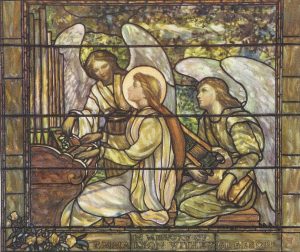
According to tradition, Cecilia was a third-century Roman noblewoman who made a vow of chastity to God. At her forced wedding ceremony, she sang in her heart to the Lord in defiance and was ultimately martyred for it. Remarkably, three blows to her neck with a sword did not kill her, and she lived long enough to request—according to some accounts—that the Pope consecrate her home as a church. That is how she earned her sainthood, and for more than a century, St. Cecilia Music Center has endured trials and tempests—seemingly under her watchful eye.
In its earliest days, the St. Cecilia Society had no building. Members met in one another’s parlors to study and perform music together. A composer would be selected. Someone would research the work. The music would be played and discussed. The ritual repeated weekly, and the group grew. By 1890, the society was sponsoring performances by world-renowned musicians. Membership expanded rapidly—from 63 charter members to nearly 800 within a dozen years. Parlors were no longer sufficient. Borrowed halls were inadequate.
So, the women did something audacious for the time: they decided to build their own concert hall.
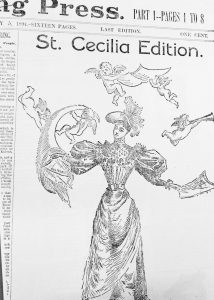
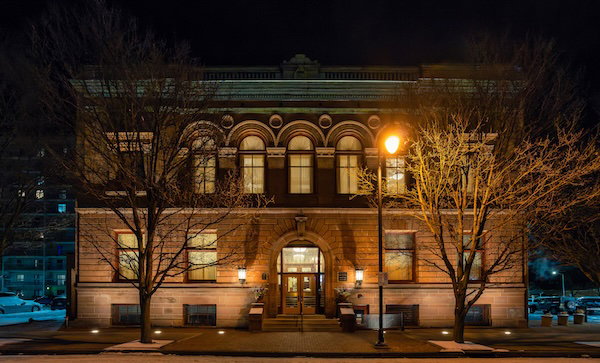
They raised funds with dinners, performances, and inventive fundraising campaigns. A “mile of pennies” aimed to collect 84,480 pennies—amounting to $844.80—which was the calculated value of pennies needed to stretch a mile long. They even took over the Grand Rapids Evening Press for a day, writing all the stories and selling the papers themselves in exchange for the proceeds. They purchased land on Ransom Avenue NE and hired prominent Chicago architect Henry Ives Cobb, who applied acoustic theories developed by Dankmar Adler—designer of Chicago’s Auditorium Theatre and a consultant on Carnegie Hall.
Construction took seven months. When the building opened on June 19, 1894, an estimated 4,000 people—nearly 10 percent of the city’s population—attended the dedication.
The St. Cecilia Society quickly became more than a venue for concerts. It became a civic platform. In 1899, Susan B. Anthony delivered a speech from its stage in support of women’s suffrage. Later, the annual women’s suffrage conference—previously held only in Washington, D.C.—came to Grand Rapids because of the Society’s reputation as a women-founded institution of influence.
Over time, it became an incubator for the city’s cultural life. The predecessor to the Grand Rapids Symphony was organized under its sponsorship in 1919. The Grand Rapids Civic Theatre and the Grand Rapids Ballet also trace their beginnings to the institution. Designated Opera Nights helped seed what would later become Opera Grand Rapids. During World War I, the building served as headquarters for the Red Cross. In the 1950s, it housed GI Bill-funded art classes.
The building itself survived multiple eras of change. In the 1960s, under the banner of urban renewal, it was slated for demolition. The community intervened. The building was saved and listed on the National Register of Historic Places in 1971, and then later renamed—first St. Cecilia Music Society, then St. Cecilia Music Center.
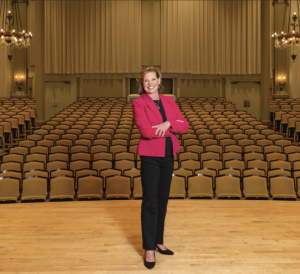
“It’s hard to look at that history and not feel a sense of responsibility,” said Executive Director Cathy Holbrook, who is marking her 20th year leading the organization.
Holbrook’s role is equal parts artistic director and steward. She oversees programming, education initiatives, and the care of a 131-year-old building that requires constant attention.
“We have to raise about half of what we need every year just to do what we do,” she said. “And with an older building, there are always surprises.”
Roofs age. Boilers fail. Systems require replacement. St. Cecilia maintains a building reserve fund and a long-term maintenance plan designed to anticipate those needs rather than react to them.
The work is guided by four core pillars: excellence, accessibility, historical relevance, and sustainability.
“We’re not willy-nilly about decisions,” Holbrook said. “Everything has to meet those standards, including how it’s going to be paid for.”
That balance—between honoring the past and remaining relevant—has shaped the organization’s evolution. Twenty years ago, St. Cecilia presented primarily classical music. Under Holbrook’s leadership, jazz and folk series were added, broadening the audience without abandoning the mission. She also elevated the organization’s profile by partnering with the Chamber Music Society of Lincoln Center, bringing world-class chamber musicians from the esteemed New York City venue to perform regularly in the hallowed hall.
“The board trusted the vision,” she said. “They gave me the freedom to dream a little.”
The expansion proved transformative. Folk and jazz performances brought first-time visitors into the building, many of whom would return for more concerts.
Once inside, audiences tend to notice the same things: the beauty of the hall, the intimacy of the space, the acoustics that require no amplification for most performances.
Artists notice it too.

“There’s a real connection between the musicians and the audience,” Holbrook said. “They feel it immediately.”
That connection was tested during the COVID-19 pandemic, when the building was closed for 19 months. One of the first streamed performances featured jazz pianist Xavier Davis playing to an empty hall.
“What struck me wasn’t the music,” Holbrook said. “It was the absence of gathering afterward. No shared conversation. No collective reaction.”
When audiences returned, they did so cautiously—and gratefully.
“It almost felt more sacred,” she said. “People had missed being together.”
Concerts are now regularly sold out. The 625-seat capacity creates intimacy rather than pressure.
“We’re not trying to fill 1,500 seats,” Holbrook said. “The people who come are true music lovers.”
Education remains central to the mission. Each week, three youth orchestras rehearse in the building, drawing students from seven counties. Programs range from elementary string ensembles to a full high school orchestra. Additional initiatives include piano and band camps, school assemblies, and Strings to Schools, a donor-funded program that brings string instruction into Grand Rapids elementary schools. Students in those programs perform their final concerts on the St. Cecilia stage.
“That’s a core memory,” Holbrook said. “They don’t forget that.”
Not all will become professional musicians. That is not the goal.
“You may not become the next Yo-Yo Ma,” she said. “But you might become the person who goes to concerts and brings others with you.”
The building also hosts weddings, community gatherings, and milestone celebrations.
“It’s a place where happy things happen,” Holbrook said. “That matters.”
St. Cecilia Music Center has survived two world wars, the Great Depression, the Spanish flu, and COVID-19. Like the saint for whom it was named, this legendary institution has also refused to surrender in the face of repeated threats to its existence, enduring as a place where music is held sacred. Holbrook attributes that resilience to generations of people who stepped forward when it mattered.
“There have always been people who cared,” she said. “Staff, volunteers, artists, donors, audiences.”
She pauses, then adds with a laugh, “Maybe some divine intervention.”
On March 8, singer-songwriter Shawn Colvin will perform on International Women’s Day—a fitting date for an institution founded and shaped by female leadership. On March 20, there’s a public open house marking Holbrook’s 20th anniversary as artistic and executive director.
She defines success simply.
“If we’re bringing people together through music,” she said, “everything else falls into place.”
The website will continue to state that the beloved music center is not a religious organization. Technically, that remains true.
But institutions that endure for more than 140 years—built on belief, sustained by generosity, and renewed through shared experience—tend to take on a life of their own. Under the quiet watch of a patron saint, perhaps, doing exactly what they were called to do.