The best interviews are not the ones where you arrive knowing everything already. Sometimes, knowing too much can turn a conversation into a performance. The subject delivers the polished version of themselves; the interviewer asks the questions they already know the answers to. There is a different kind of discovery when two people simply sit down and talk.
That is what happened when I met Tyler Loftis.
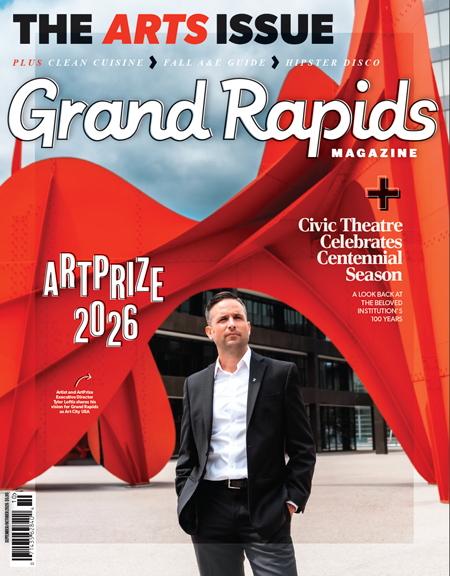
I knew he was the newly appointed executive director of ArtPrize, the international art competition that transformed Grand Rapids into a living gallery and redefined what public engagement with art could look like. I knew he was a successful painter working out of a studio in Tribeca. I knew he was from West Michigan. But I didn’t come armed with the complete mythology.
Instead, I met the person in front of me: thoughtful, charming, occasionally elusive, and someone who speaks about creativity less as something he produces than something he receives.
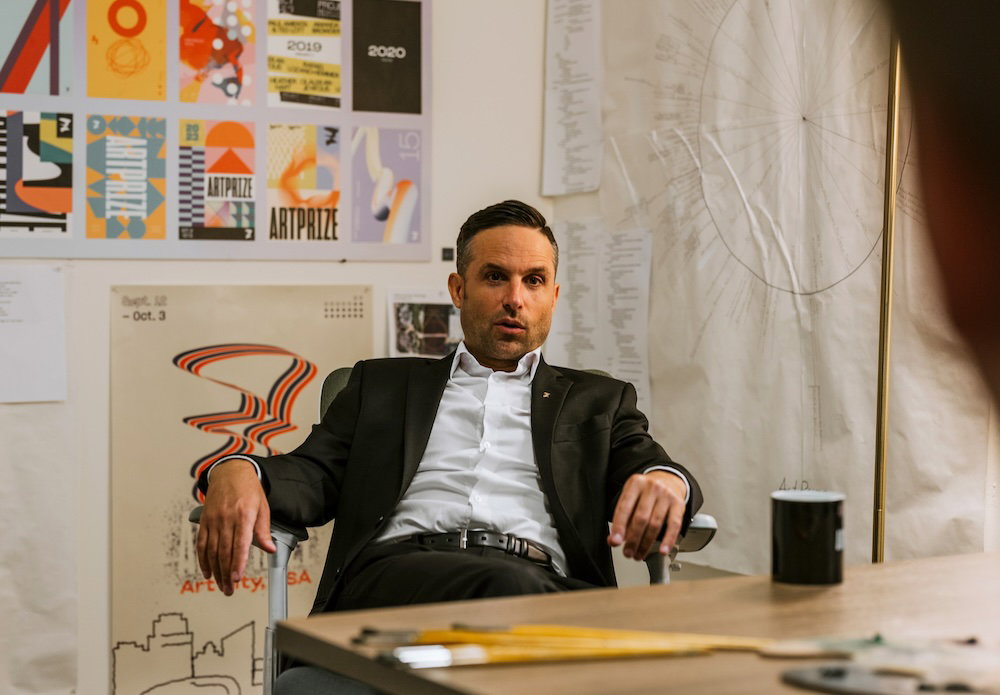
During our conversation at ArtPrize headquarters inside the Woodbridge N. Ferris Building at Kendall College of Art and Design, Loftis didn’t sound like someone unveiling a strategic plan. He sounded like a painter. He talked about purpose. He talked about responsibility. He talked about art as a record of who we are.
“Art comes through me,” he said. It’s like a “download.”
At first, I wasn’t entirely sure where the conversation was headed. Loftis speaks in the language of artists—part philosophy, part intuition, full of metaphors that resist easy packaging. But over the course of two hours, a clearer picture emerged. Everything he does seems connected by one central belief: Art isn’t meant to sit apart from people. It’s meant to connect them.
That philosophy explains far more about Tyler Loftis than any résumé ever could.
He grew up in West Michigan, in what he describes as a typical family with no particular connection to the arts. What he did have was an intense curiosity about art that soon became an almost obsessive focus on drawing. For two years, he argued with his art teacher, refusing to do anything but line drawings. Later came fashion magazines, Picasso and eventually New York, where he trained at the New York Studio School and the New York Academy of Art. Then came Europe—museum after museum, master after master. He doesn’t describe those years as finding a style. He describes them as learning from the artists who came before him.
Loftis isn’t interested in creating art disconnected from history. He sees artists as participants in a conversation that has stretched across centuries. “They’re civil servants,” he told me. Artists, in his view, have a responsibility to document their time, challenge assumptions and remind us what it means to be human.
Today, Loftis occupies an unusual place in the art world. He operates AllArtWorks viewing studio on Cesar E. Chavez Ave in Grand Rapids, maintains a studio in Tribeca, and has built a career far beyond West Michigan. His portraits hang in prominent private collections, and through his philanthropic initiative, Portraits for Purpose, he has paired portraiture with charitable giving.
Yet for someone whose paintings command serious prices, he is surprisingly skeptical of exclusivity. He believes art loses something when it becomes merely a luxury commodity. Throughout his career, he has looked for ways to remove the barriers between artists and audiences. AllArtWorks, the platform he founded, was born from that conviction. Its goal wasn’t simply to sell paintings. It was to make collecting art feel approachable—to convince people that original art belongs in ordinary homes, not just extraordinary ones. That same philosophy now informs the way he thinks about ArtPrize.
Mention Grand Rapids and Loftis’s demeanor changes. His answers become more animated, more personal. He talks about the city with the affection of someone who left, saw the world and came home convinced there was unfinished business.
His ambition is unapologetically large.
He wants Grand Rapids to become known as “Art City USA.” Sometimes he calls it “the Florence of America.”
At first, I wasn’t sure what to make of that comparison.
Florence?
Really?
Loftis wasn’t suggesting Grand Rapids should resemble an Italian city architecturally. He was talking about identity. After our interview, I dug into the history. The comparison is more thoughtful than it first appears.
Before Florence became synonymous with Renaissance masterpieces, it was an industrial powerhouse driven by textile manufacturing, commerce and banking. Merchant wealth—particularly from families like the Medici—funded artists, architects and public works, transforming economic success into cultural prestige. Over centuries, Florence evolved into a city where art wasn’t simply displayed; it became inseparable from daily life.
Grand Rapids has its own history of reinvention. Once known around the world as Furniture City, the city today is home to a diverse economy built on healthcare, advanced manufacturing, education, design and technology. ArtPrize introduced another dimension to that identity, bringing hundreds of thousands of visitors to a city willing to turn streets, parks, storefronts, bridges, museums and restaurants into exhibition spaces.
“There are a lot of similarities,” Loftis observed. “It even has a river.”
Maybe the comparison isn’t so much about Florence as it is about what happens when a city builds an identity around what it does well—and recognizes that identities can evolve.
Furniture City became Beer City. Grand Rapids built a reputation as a healthcare hub, giving rise to the Medical Mile. Loftis believes art can be the next expression of that evolution. In his mind, art shouldn’t be something visitors seek out after they’ve arrived. It should be one of the reasons they come.
That vision explains why he sees ArtPrize as something larger than an art competition. Since its founding in 2009, ArtPrize has challenged traditional ideas about where art belongs. It has invited artists into museums, storefronts, parks, office buildings, hotels, churches and public squares while asking residents and visitors alike to become part of the conversation.
Under Loftis, that conversation is expanding. This year’s festival stretches across four weekends and reaches beyond visual art to include music, dance, fashion, children’s programming and collaborations with some of Grand Rapids’ most respected cultural institutions. It’s a broader definition of creativity. A broader invitation.
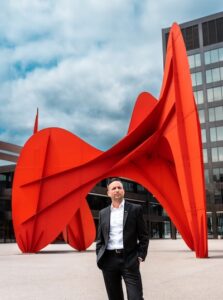
For Loftis, success isn’t measured simply by attendance or prize money. It’s measured by participation—by whether people who never considered themselves “art people” begin to see themselves differently.
During our conversation, he returned more than once to Alexander Calder’s La Grande Vitesse, the iconic sculpture outside City Hall. When I apologized for my less-than-perfect French pronunciation of its title, he smiled and reminded me Calder wasn’t French. The exchange lasted only a moment, but it captured something about Loftis. There was no art-world snobbery, no sense that art belongs to those who know more than the rest of us.
Loftis embraces Keith Haring’s philosophy that “Art is for Everybody”—an endearing quality that has likely helped propel his success and makes him particularly well suited to lead an art competition that asks an entire Midwestern city to see itself as part of the art world.
Before we wrapped up, Loftis returned to painting itself. For all the ways the world has changed, he observed, the essential act of painting has not. It’s still, as he described it, a piece of wood with horsehair on the end, dipped into pigment. The tools are astonishingly simple. They are, in essence, the same tools artists have used since people first painted on cave walls.
What changes is not the brush but the hand holding it, and the story that hand has to tell. Every generation leaves behind its own record. Artists simply happen to write theirs in paint.
For 65 years, Grand Rapids Magazine has documented the people, places and ideas that have shaped this city—not simply by recording events, but by preserving the ambitions behind them.
Whether Tyler Loftis ultimately succeeds in making Grand Rapids “Art City USA” is a story still being written. But ambition has always been one of this city’s defining characteristics. Once, Grand Rapids imagined itself the furniture capital of America. Later, it became known for medicine, craft brewing and innovation. Now, one of its own has returned home with another improbable idea: that a Midwestern city can become known around the world not only for what it builds, but for what it creates.
It’s a lofty goal.
Then again, every great idea begins with one.
What to Expect at ArtPrize 2026
ArtPrize 2026 festivities in downtown Grand Rapids on Friday, Sept. 18 at 5:30 p.m. at Rosa Parks Circle, where guests can kick off the evening with drinks, activities, and a few unexpected characters before gathering for the opening parade.
At 7 p.m., the ArtPrize Opening Parade will make its way from Rosa Parks Circle to the Pearl Street Bridge, carrying the celebration into the heart of downtown. Once there, guests can continue the festivities with music from DJ Monk, drinks, and more.
At 8:30 p.m., William Close & The Earth Harp Collective will take the stage for a one-of-a-kind musical experience. The world’s longest stringed instrument will stretch across the Pearl Street Bridge, transforming the city and its surroundings into an immersive musical setting.
The evening will conclude at 9:30 p.m. with a spectacular fireworks display over the Grand River, officially launching ArtPrize 2026 in grand fashion.
Important Upcoming Dates
Sept. 19 — Grand Rapids Opera: Due to the weather forecast, the Opera Cabaret has moved from Rosa Parks Circle to DeVos Place Grand Gallery.
Sept. 26 — Doodle Street, an interactive children’s art experience with Downtown Market.
Sept. 26 — ArtPrize Halftime Party at John Ball Zoo, featuring live painting and family programming.
Oct. 3 — Break a world record: RC Caylan Atelier presents a fashion show during the ArtPrize Awards Celebration at Acrisure Amphitheatre. Free General Admission tickets are available to the public at AcrisureAmphitheater.com. Tickets are required for entry. VIP tickets will be available for purchase, including an open bar from 6:30-8 p.m. The event is aiming to break a Guinness World Record for “Largest Attendance at a Fashion Show”
Throughout the event — SouthPrize extends ArtPrize into the Third Ward through a partnership with the Southtown Corridor Improvement District, creating an additional neighborhood-based celebration of art.
ArtPrize Venues
Artwork will be displayed throughout Grand Rapids at participating museums, galleries, businesses, public spaces and unexpected locations. ArPrize’s featured venues include Cūra Gallery at Silva, Grand Rapids Art Museum, DeVos Place, Acrisure Amphitheatre, and many, many others. This is not an exhaustive list of venues—as always, artists will be exhibiting across the city throughout the event! For a complete list of venues, visit https://www.artprize.org/venues