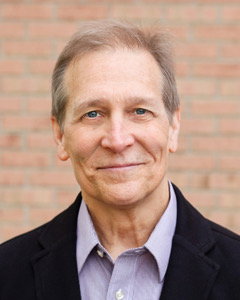
“People need a story to tell about their cancer,” Dr. Bill Romanowski said as he began to talk about his prostate cancer diagnosis. “They need a metaphor for it. Some use the word ‘journey,’ others may say it’s a ‘battle.’” But not Bill. He chose a different metaphor for the severe and difficult emotional and physical test cancer was for him:
“I call it a ‘crucible.’”
No surprise, really, that Bill would be thoughtful in his word choice. He is a retired Calvin University professor of Communications, an author and blogger who understands how language shapes experience. He has written seven books and is working on another, this time a historical fiction novel.
Bill is literally a man of many words.
When prostate cancer came into the picture in 2011, he vividly described the words used during the call informing him of his test results: “…results of your biopsy…. unfortunately…cancerous…schedule more tests….” Someone whose thoughts had always produced coherent and copious written records struggled, in that moment, to form a continuous thought. His crucible was already showing up as an intense and difficult experience.
Bill is a gregarious storyteller, full of positive energy and a ready smile. He kept his diagnosis quiet at first because he didn’t know how others might react. Then friends encouraged him to use his writing talent to chronicle his cancer experience. He decided to write both a blog and a newsletter.
His motivation? To help others.
Deciding to be the first
Bill takes caring for others very seriously.
Which is exactly what he said about his own doctor during an interview together at BAMF Health. “He really cared for me,” he said, looking over at Dr. Brandon Mancini.
BAMF Health opened its doors in 2022, with Dr. Mancini as its first Medical Director. The center is “super sub-specialized” in treating prostate cancer and neuroendocrine tumors. Brandon’s education has ranged from psychology to oncology to business administration, and his philosophy is human-centered: “We can’t always control the outcomes,” he said, “but we can control how we make people feel and how we value their lives.”
Bill and Brandon’s paths crossed after Bill had undergone many treatments for prostate cancer, including surgery, radiation, medication and chemotherapy. He continued to have positive margins, a sign that the cancer was persisting. His oncologist referred him to BAMF Health, where he met Brandon.
At that first appointment, Brandon reviewed Bill’s history and told him he was eligible for an FDA-approved treatment plan. But Brandon had other news: Bill was also a good candidate for a clinical trial so new that he would be the first person ever to try it.
After Brandon described the trial in detail, he asked Bill if he had any questions.
“Just one,” Bill said. “Where do I sign?”
They both laughed as they recalled the moment. Brandon said Bill was ready to go immediately, but clinical trials require a 24-hour waiting period before a patient commits. This gives patients time to think things through and get answers to their questions.
As soon as he could, Bill signed on.
When asked why he was so eager to participate, Bill said the clear and compassionate way Brandon described the trial gave him confidence. He was also honored to be the first to try the treatment.
“I trusted him,” Bill said, “and I have a son, I have nephews, and I want to help others who also receive a devastating diagnosis like mine. It’s all about loving your neighbor.”
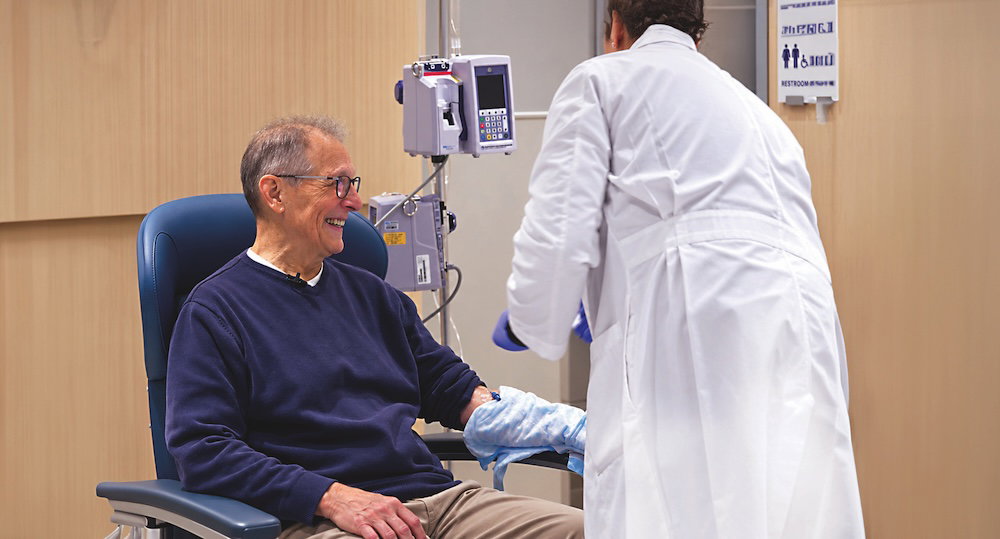
Bill started the trial in November 2025. The imaging agent used in the trial gives off signals showing where targeted cells are located. When the body is scanned, the signals light up. A former film studies professor, Bill said his detailed and colorful scans “look like a 4K science fiction movie.”
That December, he began Pluvicto, a treatment that both creates signals and provides therapeutic treatment—a two-pronged “radiopharmaceutical” approach. His six treatments included infusions followed by scans using a total-body PET/CT scanner with twice the resolution and 40 times the sensitivity of conventional scanners. It is also much faster, taking as little as five minutes instead of 40.
The procedure has minimal side effects. Bill’s numbers are looking good, and he is getting his energy back. He knows he may need additional treatments in the future, another part of the crucible that is cancer.
He is grateful to be in remission.
A pioneer in theranostics
BAMF Health uses theranostics, combining therapeutic treatment with diagnostic imaging to precisely find and treat prostate cancer. Its specialized technology is designed to reduce the wait between diagnosis and treatment.
BAMF is building a center in Detroit in partnership with Henry Ford Health, with other centers planned for Missouri and Virginia.
Research is always evolving. Pluvicto was approved in March 2022 for patients who had already tried conventional therapies. In 2025, it was also approved as an initial treatment for newly diagnosed prostate cancer that has spread.
Clinical trials like the one Bill participated in are helping develop these new approaches. In Bill’s case, the trial aimed to determine whether its imaging agent could detect prostate cancer as well as or better than currently available imaging agents.
“Someone has to be brave and volunteer,” he said.
Others had participated in trials that helped develop the treatments he had already received. Now it was his turn to help others.
Brandon is proud of the work BAMF Health is doing. In 2025, people from 26 states and other countries were treated there. The center is designed to conduct clinical trials efficiently and get study results more quickly, helping advance the field.
Radiopharmaceuticals are created on site, lowering costs, while the time between diagnosis and treatment can be substantially reduced.
“There is not another center in the whole world that is built like this. We are a vertically integrated and comprehensive theranostics center.”
Beyond the technology, Brandon emphasizes the human side of their approach: “So much control is taken away when you have cancer; we are trying to give patients as much agency as possible.”
He noted that, at the time of the interview, 40% of BAMF’s treatments were part of clinical trials, covering roughly 15 cancer types. He said the industry standard is about 6%, and BAMF is among the top enrollers in several trials.
Humans at the center
Brandon knew early that he wanted to go into oncology. He also wanted to balance his scientific understanding with knowledge of how people think and interact.
His undergraduate work was in psychology. He put that knowledge to use as class president during all four years at the University of Michigan, helping improve interactions between administrators and students.
“I try to do my best as a person and treat everyone the way I’d want to be treated.”
How does he measure success?
More birthdays for his patients to celebrate.
Likewise, Bill’s life is centered on how he can contribute.
“When I can be a part of things that BAMF does and tell people stories, help them, and write about it, it gives purpose to my experience and takes what I can do and does something more with it.”
He thinks of it as redeeming the situation.
When asked what he might say to others just taking up the crucible that cancer is, Bill said, “It’s an opportunity to carry on with your life in a way that is invested with more meaning: ‘What’s important in my life? What are things I want to accomplish? What about my family?’ Do what you can do and communicate with others about it.”
Brandon emphasized a similar personalized approach: “Find a treatment path that aligns with what you want. Some may be hesitant about certain therapies. What’s amazing about West Michigan is that all of the best treatments can be found here.”
“BAMF Health’s goal is to provide the best in the world in patient experience, the best imaging, the best patient interactions, and the best human touch involved within that person’s crucible. We have the only two of these specialized scanners in the country. We are paving the way for theranostics to be one of the most meaningful cancer therapies that has ever existed and we want to lead the world in how this is done. It’s all about improving people’s lives.”
And as for his patient Bill’s own crucible?
“We’ll keep an eye on things so Bill can continue to laugh and tell amazing stories.”
That’s fine by Bill. He has his sights set on becoming a published novelist and returning to speaking to others about stories and the human experience.
“I hope to get back on the road again.”
And about that historical fiction novel he’s looking forward to publishing in 2027? Bill’s answer, in a way, is a metaphor, too:
“I’ve already started on a sequel to it.”