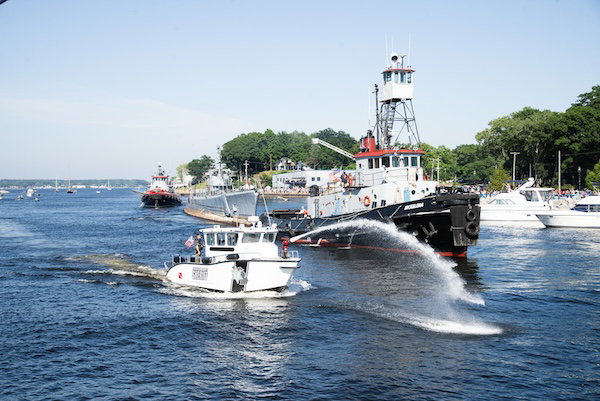
One of the most significant museum ship preservation projects ever undertaken on the Great Lakes began July 13 of this year when World War II submarine USS Silversides departed Muskegon for a carefully planned tow across Lake Michigan to Fincantieri Bay Shipbuilding in Sturgeon Bay, Wisconsin.
The voyage marked the first time in decades the 312-foot Gato-class submarine had left its berth along the Muskegon Channel, where it has served as the centerpiece of the USS Silversides Submarine Museum since 1987. Two tugboats, Nickelena and Erika Kobasic, guided the submarine through Muskegon Lake, down the channel and into Lake Michigan before beginning the approximately 20-hour crossing.

The submarine’s departure drew hundreds of spectators to the shoreline and piers, while dozens of recreational and commercial vessels assembled on Muskegon Lake and in the channel to escort the historic warship on the first leg of its journey. As the tow passed through the channel, boaters sounded horn salutes in tribute to the submarine, creating an unforgettable sendoff for one of the nation’s most decorated surviving naval vessels.
The tow was far more than a relocation. It represented the beginning of a $3.5 million preservation project designed to ensure the long-term survival of one of America’s most decorated submarines.
Commissioned just days after the attack on Pearl Harbor, USS Silversides completed 14 war patrols in the Pacific during World War II, sinking 23 enemy vessels and earning a Presidential Unit Citation along with 12 battle stars. Today, the submarine is recognized as a National Historic Landmark and is considered one of the finest surviving examples of its class.
Although museum volunteers have maintained the vessel for decades, much of the submarine’s hull has remained below the waterline, making comprehensive inspections impossible. Once in dry dock, preservation specialists were expected to remove marine growth, inspect and repair steel plating, evaluate structural components and apply new protective coatings intended to preserve the vessel for generations to come.
The project is the first opportunity in many years for engineers to fully examine the submarine’s underwater hull and address deterioration before it threatens the vessel’s long-term integrity. Museum officials have described the work as the most important preservation effort since the submarine became a museum ship.
Following completion of the preservation work, USS Silversides is expected to return to Muskegon in mid-October 2026. Museum officials anticipate the submarine will resume its role as the centerpiece of the USS Silversides Submarine Museum at 1346 Bluff Street in Muskegon after spending approximately three months in dry dock undergoing hull inspections, steel repairs and protective coating work that cannot be performed while the vessel is afloat.
As the submarine slowly cleared the Muskegon pierheads and headed west, it offered a rare reminder that preservation sometimes requires movement. While USS Silversides once crossed the Pacific on wartime patrols, its latest voyage carried a different mission: safeguarding an irreplaceable piece of American naval history so future generations can continue to experience one of World War II’s most accomplished submarines firsthand.