Model train people are serious about their hobby. They speak their own language with phrases such as HO scale and Centralized Traffic Control Panel and double track; they have their own clubs, stores, and flea markets; they have basements and attics covered in tracks, trains, and tiny trees. And these folks will talk about trains until the last whistle blows and the final car pulls into the station.
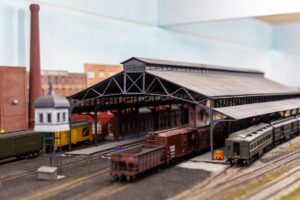
The Grand Rapids Model Railroad Historical Society meets Tuesday nights at its Comstock Park headquarters at the back of Dwight Lydell Park to talk trains and work on their layout. They have an HO scale, double deck layout representing the Pere Marquette Railroad as it existed in the late 1940s between Plymouth, Mich., and Chicago, Ill. Members have recreated stops in numerous cities including the old Wyoming yard and the Grandville/Hudsonville stop.
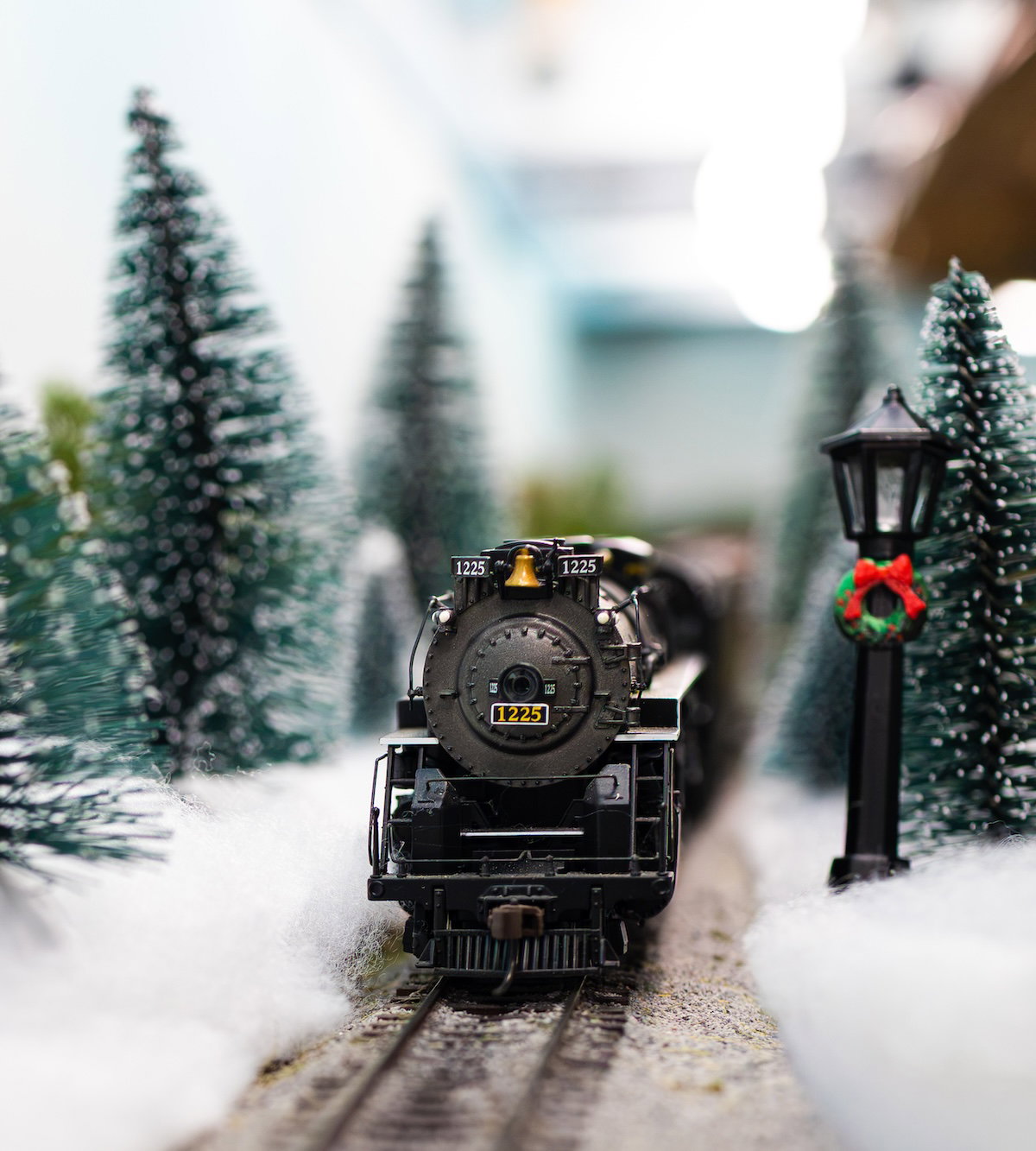
The 1,000 feet of track represent 180 miles of the Pere Marquette line. The tiny trains chug through hand-painted landscape replicas of that era that include storefronts, trees, streams, people, cars, barns, and even animals. It’s a miniature extravaganza of detail, detail, detail all put together by dedicated model train enthusiasts. The club hosts several open houses for the public including Nov. 21 from 11 a.m.–4 p.m., showing off its Pere Marquette 1225 engine. The real-life PM 1225 inspired Chris Van Allsburg’s “The Polar Express,” a Caldecott Medal winner published 40 years ago. Van Allsburg grew up in East Grand Rapids.
Skip Luyk helped start the GRMRHS back in 1992. The club has had 123 members over the years, with 19 current members. “Trains are a fabulous transportation system, with a tremendous history of building this country,” he said. “The interest in railroading brings us together as people.”
Mark Baldwin, also an early member, remembers riding the switcher, a small engine, in the railroad yard with his dad, a firefighter who “knew people” who could offer the boy and his dad rides. They had belonged to a now-defunct club before, then helped start this one.
“I like the escape and the challenge,” said Baldwin. “I love the history and research part, going to museums and libraries to research the Pere Marquette line.”
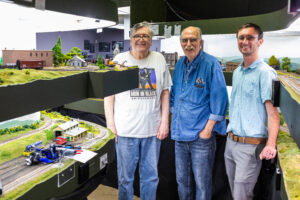
Club members range in age from men into their 90s to those in their 20s and 30s, with the occasional youngster tagging along. While many train enthusiasts are men, women are interested as well. Many enthusiasts also have their own model railroads at home.
Luyk has a layout of a logging operation in the Pacific Northwest. Legend has it that a model railroader once designed the basement of his new home for his railroads and let his wife design the rest of the house above him.
Les Miner, in his late 20s, has been a club member for four years and also has a model in his basement. He recreated the Ashtabula Branch of the Pennsylvania Railroad that ran from Pittsburgh to Ashtabula and hauled iron ore from the lake boats to the steel mills.
“My favorite thing is the ability to apply my skills to a larger goal, the club layout, while also learning from experts in other areas,” said Miner. “I do electronics, but others are great at scratch building and paining. I can learn the tricks of other areas of railroading without having to trip over myself as much along the way.”
Just inside the door of the GRMRHS sits a green Centralized Traffic Control Panel full of toggle switches and lights, which controls where and when the model trains move around the tracks. It models the old way trains were monitored and switches controlled in the 1940s, which is now done via computer. Miner ran hundreds of feet of cable throughout the layout to help make it all work.
For member Kevin Clark, “I’ve always loved trains and the logic of how you control where they go. I love the hardware and the computer component.”
“I also really like the people,” said Clark, who has been in the club a couple of months. “There is no competition here because we’re all here for a purpose. People are kind and accepting and from all walks of life who enjoy each other and enjoy models and trains.”
Model railroading pieces and parts come from flea markets, trade shows, eBay, donations from train enthusiasts or their loves ones, their own yards for stones and dirt, and places like Rider’s Hobby Shop on 28th Street. According to branch manager Bill Mosey, model railroading stock takes up about 25 percent of the store’s shelf space and is about 20 percent of total sales.
He said the old Lionel trains—called O Scale or O Gauge models—make up only about 5 percent of the hobby today, with 80 percent of model railroaders working with HO scale models. HO Scale is a 1:87 ratio model train size, meaning its 87 times smaller than a real train and half the size of the large O scale trains (HO stand for Half O). There are a number of other scale sizes.
According to Mosey, model railroading “is all about creating real life in miniature and idealizing that life. Some people are into the trains, and some are as much about the layouts and towns.”
For Jerry Frye and his store called Hobby Recycling, it’s 1,250 square feet of nothing but used trains and modeling paraphernalia. About 50 percent of sales are HO scale, 30 percent the smaller N scale, and the rest is a variety of scales.
“I like the people who are interested in trains; they are good bunch of nice people,” said Frye, who has been selling model train stuff for 35 years, 30 at his Lee Street location. “We’ve seen more kids lately. The pandemic pushed kids into looking for something to do. One kid told me he’s sick of looking at computers and remembered his grandpa had a train in his basement.”
Jake Abel, who works at Rider’s Hobby Shop, is a member of the Grand River Valley Model Railroad Club, which rents basement space on Porter Street SW. The club has two different models, one a double track for people to run their trains and the other a single track under construction. Both are freelance, which means that the layouts model no specific place or time period.
“I like having a place to run my own trains and compare notes,” said Abel. “Everyone gets something a little different from the hobby. They might like the engines and cars, the scenery, or the thought processes that go into modeling.”
Therein lies part of the allure of model railroading—learning the skills involved in building a model railroad. There’s carpentry to build the base; welding for tracks and trains; design to create the model; math for scaling; electronics and technology to run the models; painting for everything from recreating tiny fence posts to aging an engine to look authentic; research for accurate modeling; problem solving, and more.
Abel sums up the world of model railroading well. “The deeper you dive, the more you find.”
MORE ON TRAINS
Santa Train
For folks looking for a life-size train ride, don’t miss the annual Santa Train run by the Coopersville and Marne Railroad. Runs weekends between Thanksgiving and Christmas. Buy tickets early as the Santa Train fills up quickly (mitrain.net/train-rides/santa-train/).
Train Sale
The Grand Rapids Model Railroad Historical Society hosts its annual train sale for buyers and sellers on Jan. 9, 2027, at the KC Event Center in Wyoming. Visit grmrhs.org for details.
National Organization
The National Model Railroad Association, based in Soddy Daisy, Tenn., has districts and regions all over the world, many holding annual or bi-annual conventions. Visit nmra.org for details.
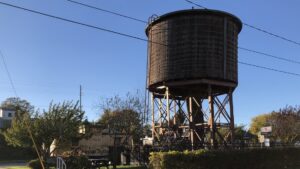
All Aboard: Because Grand Rapids Magazine loves a good restaurant—and train lovers deserve a good meal, too—this story wouldn’t be complete without a nod to The Depot Restaurant, 22 W. Main St. in Grant. Housed in an 1891 railroad depot, it’s packed with train-themed charm, classic comfort food, a caboose for photo ops, and actual trains rolling by right outside.