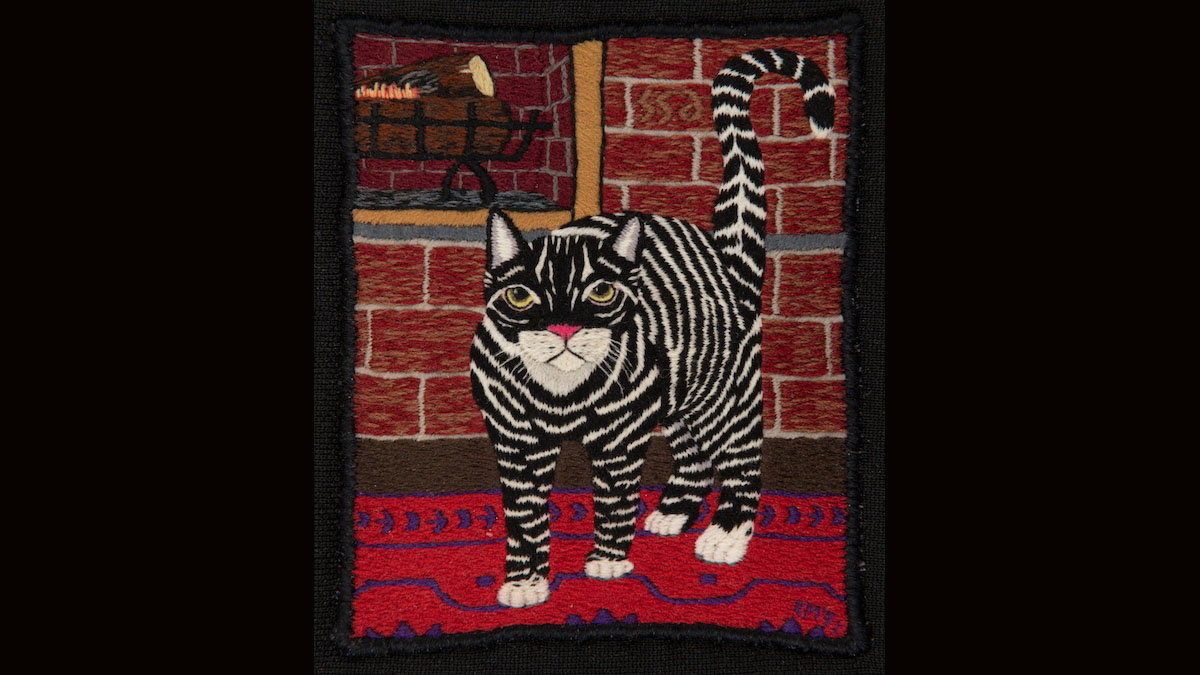
Ray Materson makes art with socks—though you’d never guess it from a first glance.
The Grand Rapids native painstakingly unravels ordinary sock threads and stitches them into palm-sized scenes filled with portraits, memories, Americana, literature and fantasy. But the unusual medium has a much more complicated origin: Materson developed the technique while serving a prison sentence in his 30s in the late 1980s.
The idea was sparked by a childhood memory of his grandmother embroidering on her porch. With little more than thread pulled from socks and a needle, Materson began making tiny portraits and patches for people around him. What began as a way to create something in an environment defined by confinement eventually became a lifelong artistic practice.
This fall, the Grand Rapids Art Museum brings that work home with Ray Materson: Metamorphosis, opening Oct. 3. Spanning more than three decades, the exhibition follows Materson’s evolution from works made during incarceration to recent pieces inspired by portraiture, Americana, literature, folklore and fantasy.
The work is remarkably small. Untitled Cat, for example, measures just 3 by 2½ inches. But the closer you look, the more there is to see: tiny figures, gestures and details rendered in threads painstakingly separated from everyday socks.
“The wide range of experiences and creative approaches between these artists have a powerful resonance,” says Jennifer Wcisel, GRAM’s Dean and Helga Toriello Curator of Collections and Exhibitions.
Materson’s story is part of a larger fall presentation at GRAM examining creativity and the American criminal justice system. Julie Green’s The Last Supper brings together nearly 1,000 painted plates depicting the final meals requested by people executed on death row. Gary Tyler’s Rebirth features quilts developed from a practice he learned during more than four decades of wrongful incarceration.
But Metamorphosis offers a particularly Grand Rapids story: an artist who began making tiny things to occupy a confined life, then spent decades expanding what those few inches—and a few strands of thread—could hold.